 Wingware
Wing 12.1 Beta: Getting Started with Autonomous Development
This page explains how to get started with autonomous software development using the Wing 12.1 beta release. For an overview of the capabilities of autonomous developement and everything else that's new in Wing 12.1, see the Wing 12.1 Early Access page.
Getting Started
We recommend using a reasonably isolated environment, such as a virtual machine, when using AI agents. At the very least, you should prevent agents from accessing the keys to your server infrastructure, reading sensitive data, or pushing to your main repository.
To get started you will need to:
(1) Install Wing Pro 12.1 from the Wing 12.1 downloads. After installing, use Check for Updates in Wing's Help menu so that you have the latest hot fixes. Wing 12.1 replaces Wing 12.0 when it is installed, but you can revert to Wing 12.0 by reinstalling it at any time.
(2) Install an AI agent and set up an account for it that covers the amount of work you expect to do. For sustained use, a subscription is generally much cheaper than paying for usage on an API key. For autonomous development with the Tasks Manager, we recommend Claude Code or Codex (run with its TUI) because these are the only agents with safety checks that are robust enough to support unattended use. Antigravity, Copilot, and Cursor also work, but without those safety checks. OpenCode, goose, and other agents that speak the Agent Client Protocol are not yet recommended for autonomous use. See Limitations below for details.
Setting Up an AI Agent in the AI Agent-Assisted Development chapter of the Wing 12.1 manual, available from Wing's Help menu, describes how to set up each type of agent.
(3) Enable version control with git or Mercurial. Wing uses it to track, review, and commit each task's changes. You can ask your agent to set it up for you, for example by initializing a local git repository.
(4) Create a new project from Wing's Project menu. Choose your agent, enable the Autonomous Tasks Manager, select a new or existing project directory, and choose a Python environment configuration. Wing writes guides into a .wing directory that tell every agent how to work with Wing and your project, and points AGENTS.md at them.
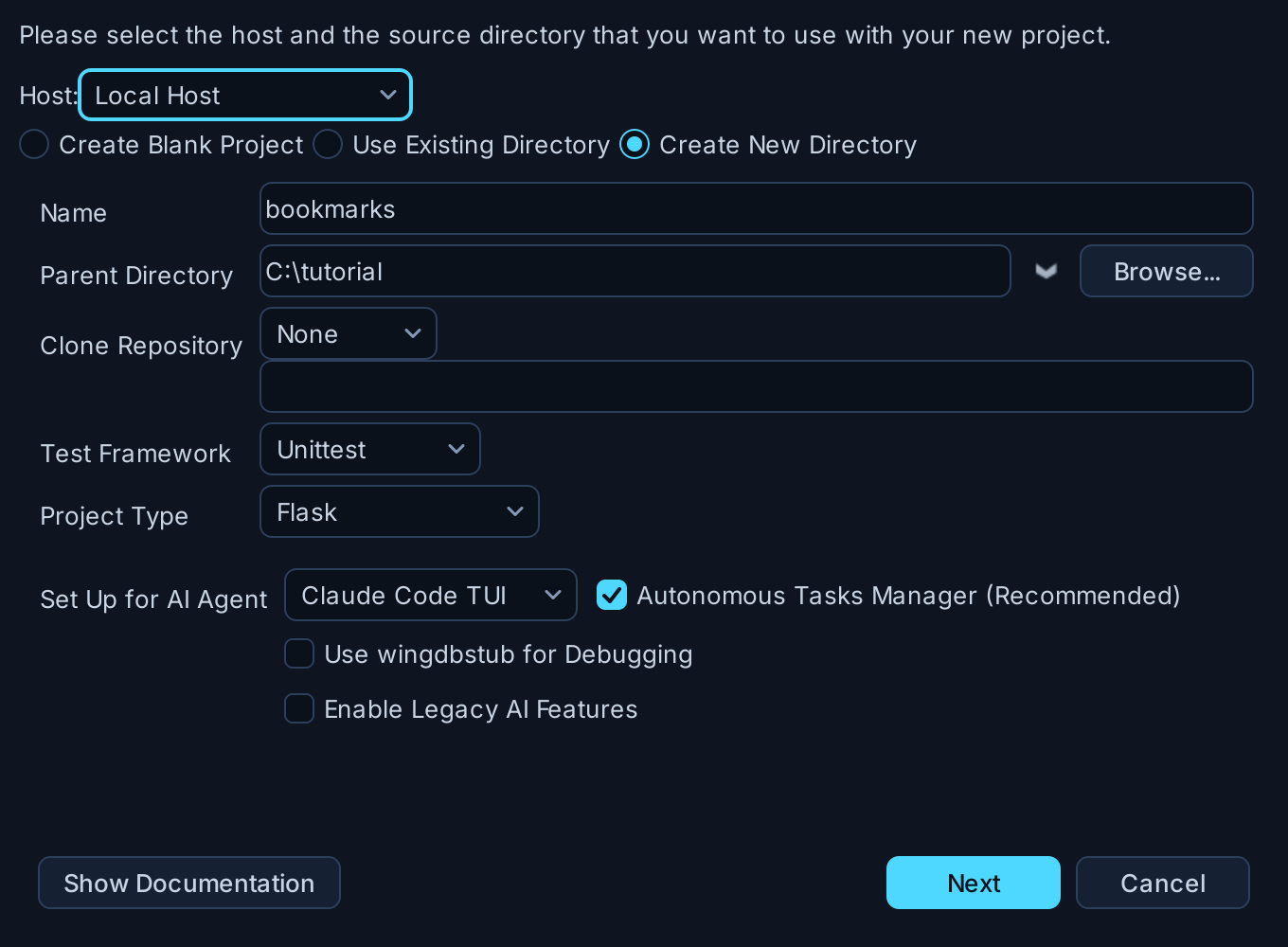
Shown above: Setting up a new project for an AI agent.
(5) Set your policies. On the AI Agent tab of Project Properties, accessed from Wing's Project menu, choose the Testing Regimen to tell agents when to write and run unit tests, and decide what agents may do without asking, such as editing project files and running commands. Be sure to ask agents to write tests for new code: without tests, workers can't always tell whether their code works, so autonomous work could produce inaccurate results and may stall. You can describe your other development policies and details of your workflow to an agent and ask it to write them to AGENTS.md or other shared files.
(6) Write a specification or tasks. On the Plan tab of the Tasks tool, add tasks and mark them Ready. A task can be as small as a single bug fix, or it can be a high-level specification of a feature or a whole application. A specification should describe the purpose and key features, and any technical constraints that matter from the start, but it doesn't need to be detailed: ask for it to be researched and broken into tasks. The Manager runs the research, asks what it needs to know, and puts the resulting tasks on the Plan tab. This works for an empty project as well as an existing one.
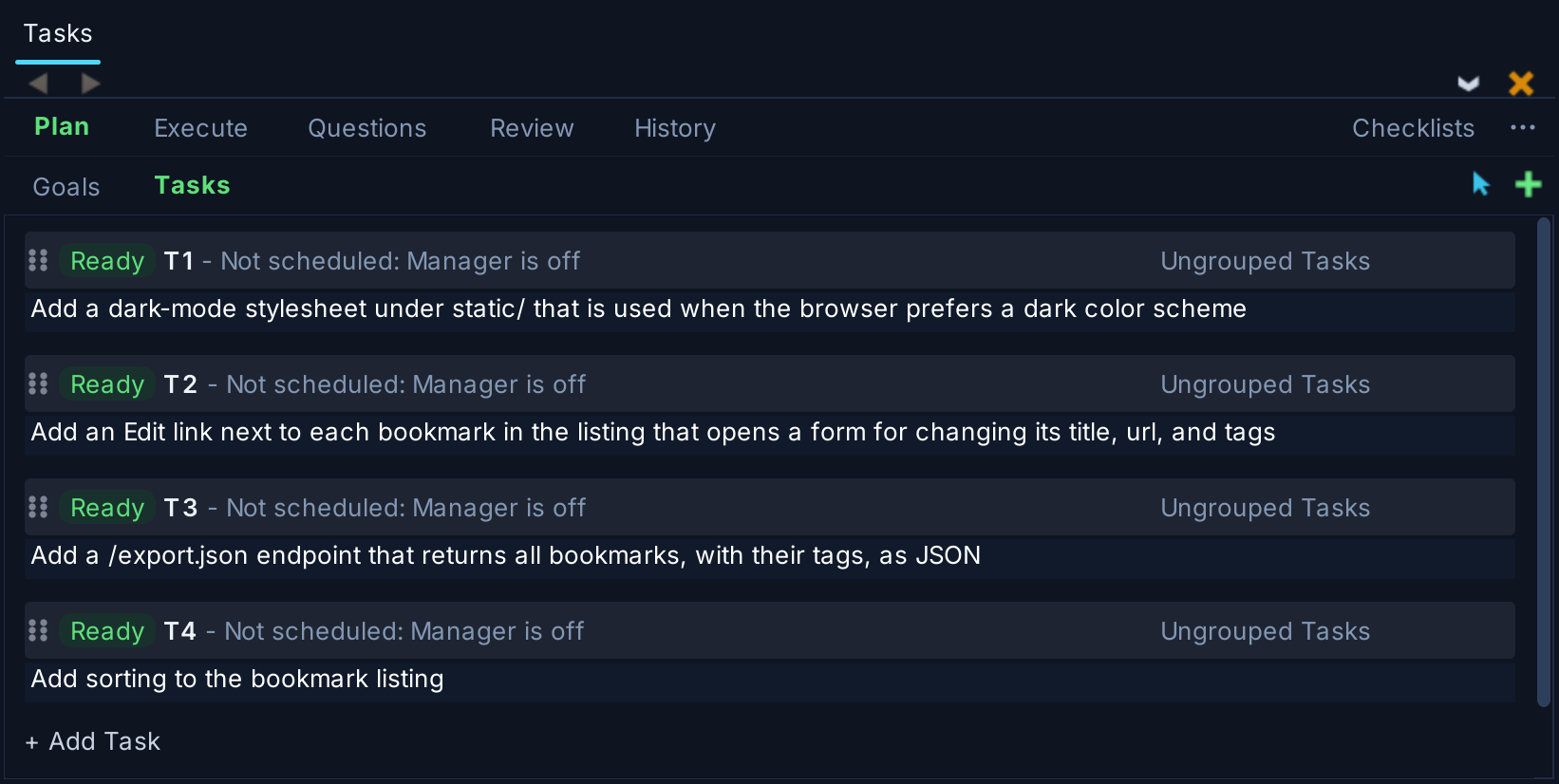
Shown above: Tasks on the Plan tab, marked Ready.
(7) Turn on the Tasks Manager. Wing doesn't turn on the Tasks Manager automatically. To enable it, click Turn On in the Manager's bar at the top of the Execute tab. The first time this is done, Wing asks for its settings: which agent to use for the Manager, whether to lean towards making and recording decisions or stopping and asking questions first, how many workers may change files at once, and whether finished work is committed automatically or left for you to review first.
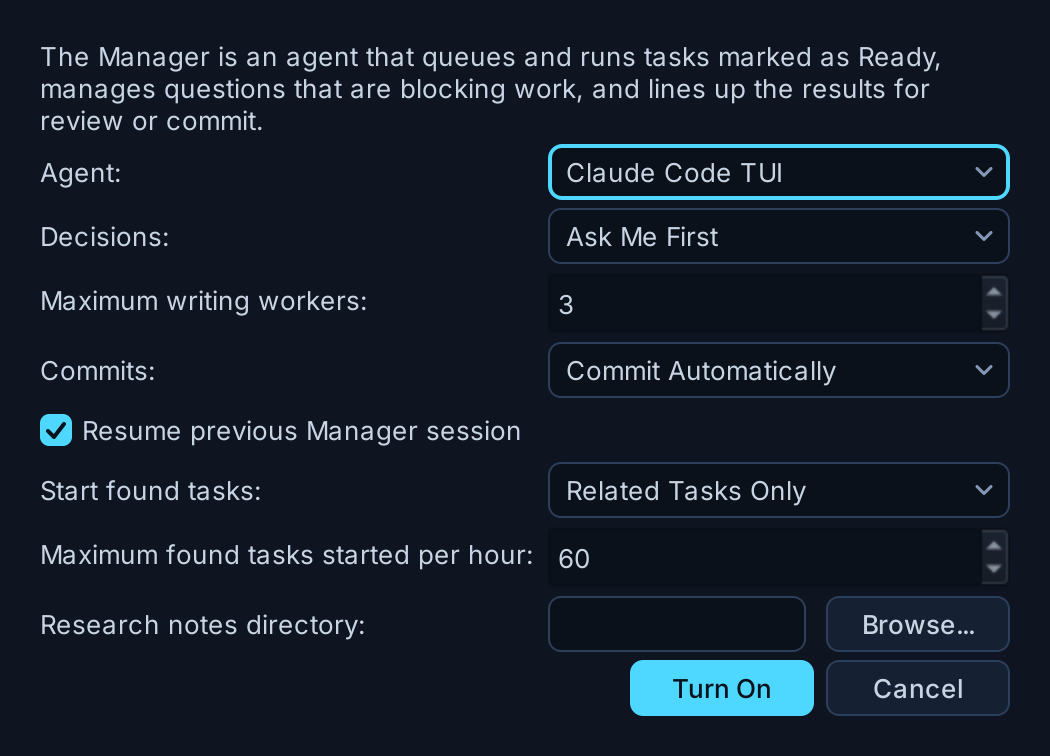
Shown above: Choosing the Tasks Manager's settings the first time it is turned on.
We recommend choosing Commit Automatically for larger jobs that run many tasks. Uncommitted work holds up later tasks that touch the same files, so with manual commits the Manager often has to wait for you before it can go on. When it commits each task once its tests pass, the work can run to completion while you are away, and you can still look over every committed task on the Review tab and request changes.
Once the Manager is on, it starts running the tasks you marked as Ready in step (6). You can watch their progress from the Execute tab of the Tasks tool. Click on the queue names to see the session in action, in the AI Agent tool.
(8) Answer questions. An orange count on the Questions tab shows when an agent is waiting for your feedback. Answer each question in place, and the task carries on. If possible, the Manager may start new tasks while others are waiting for you. You can also talk to the Manager directly, to ask about task status or give it instructions such as "ask me first about anything that changes a file format".
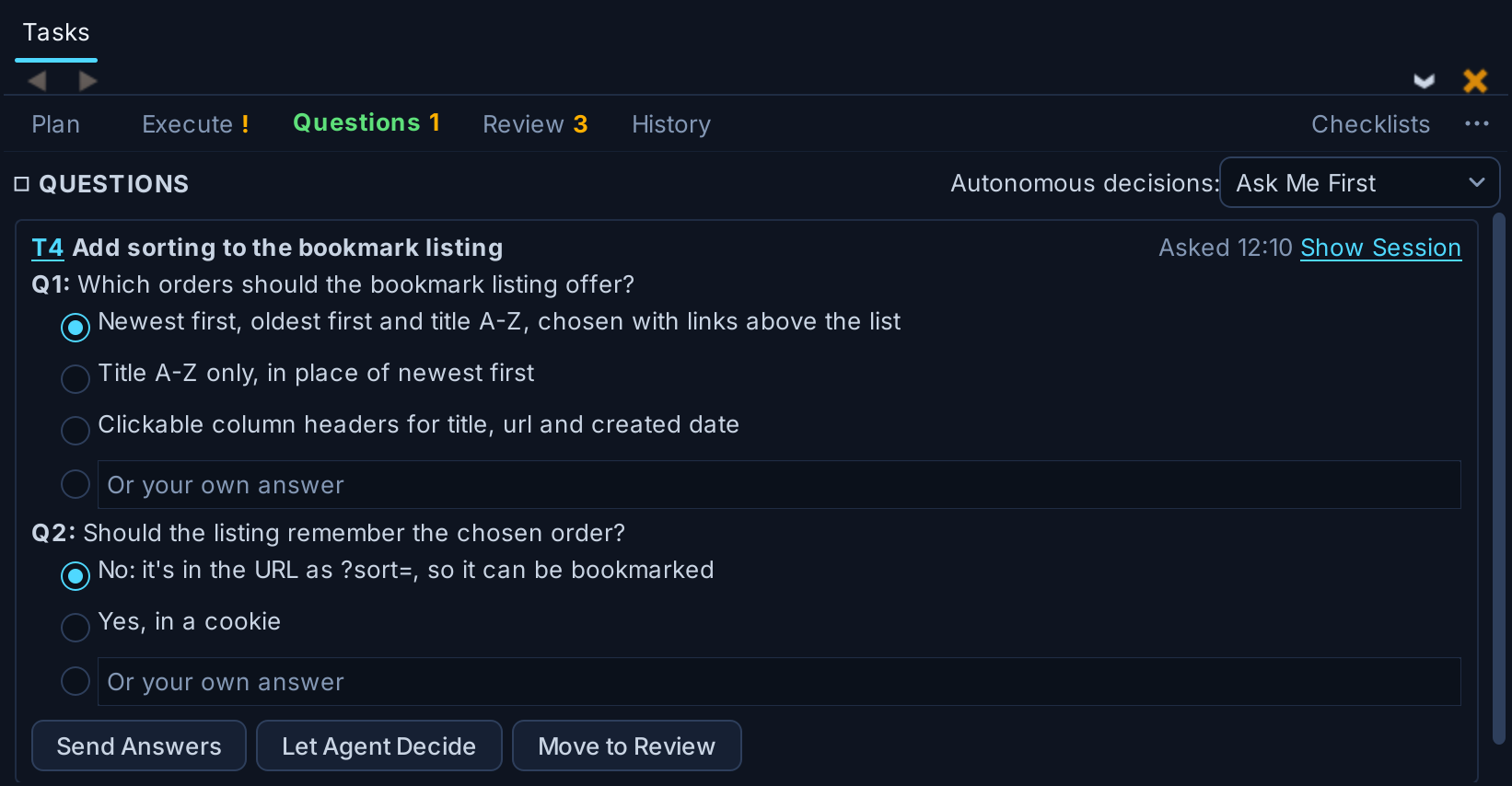
Shown above: A question from a worker, waiting on the Questions tab.
(9) Review finished work. Finished tasks move from the Execute tab to the Review tab. Each task reports a summary of the decisions and changes it made, and you can reject or revisit each one. If you are committing work yourself, you can do that from here with Start Review to view and comment on code-level changes, or Commit to commit without further review. If the Manager committed for you, you can still read its report here and ask it to revise any of its listed decisions.
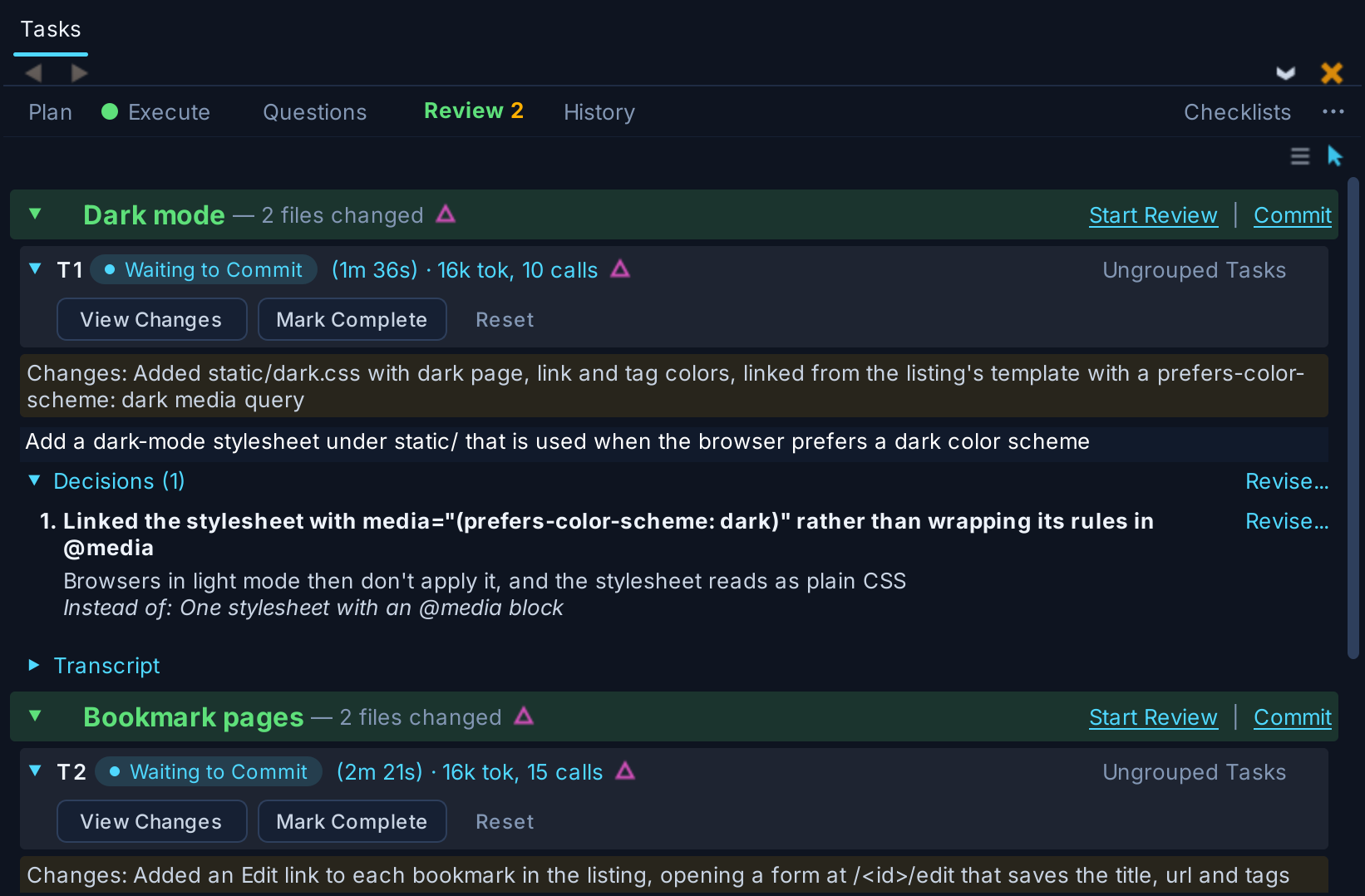
Shown above: A finished task's report on the Review tab.
Staying in Control
Whether you start right away using the autonomous development mode in Wing Pro is up to you. If you are unfamiliar with agentic development, you may prefer to start with a single agent and review every change at the code level. Your comfort with this will change over time. Once you see that agents write and run tests reliably for your project, you may find yourself reading tasks' completion reports and committing without looking at the code. That may be the right time to move on to autonomous development, shifting your focus from individual agents and their output to specifying tasks, answering questions, and reading completion summaries.
Whatever pace suits you, these habits help build that confidence:
- Use the application yourself, as much as you can, and add tasks for the bugs and improvements you find. Where that isn't practical, ask agents to write tests that act like a live user, taking the application through all the functionality that real users can reach.
- Schedule review passes at key points using separate tasks that look for security flaws, data loss bugs, gaps in test coverage, missing functionality, or compatibility problems between versions. Each one can turn up issues that become new tasks.
- Commit automatically on a separate branch. If you let the Manager commit on its own, development can go on for long periods without waiting for you, and a review task can compare the working branch with your main branch before you merge it.
The common thread is to build tests and cross-checks into your process, and to give agents the means to see the results of their own work so they can auto-correct any problems. In autonomous development, the work is done by many agents, each checking the work of others.
Limitations
The following known limitations exist in the current early access release:
(1) Only Claude Code and Codex (run in its TUI) are recommended for autonomous development with the Tasks Manager. Claude Code is currently most tested with real-world work. Antigravity, Copilot, and Cursor run the Tasks Manager well in their TUIs, but do not implement the same level of safety checks. goose, OpenCode, and the ACP versions of Antigravity, Codex, and Cursor are not recommended, because they can ignore your run mode and pre-approval constraints or lack features that the Tasks Manager needs. Wing warns when your selected AI agent has these problems, before tasks are started. AI Agent Safety in the AI Agent-Assisted Development chapter of the manual in Wing 12.1's Help menu compares the agents and provides details on each.
(2) AI agents are not yet supported for projects that run Python in a container or cluster. Please let us know if this is an issue for you.
Further Reading
The Wing 12.1 documentation is available from Wing's Help menu after installing. See the AI Agent-Assisted Development chapter, especially AI Agent Safety, The Tasks Manager Agent, and Using AI Agents Effectively, for setup instructions for each type of agent and a full description of the Tasks Manager.
This is a beta release. Please try it and email us if you find problems, have suggestions, or have any questions.