 Wingware
Wing Pro 12.1 Autonomous Development Test: Desktop Aquarium
This demo tests the autonomous Tasks Manager in Wing Pro 12.1 on a complete project, built from one prompt: tankful, a desktop aquarium written in Python with the UPBGE game engine. The Tasks Manager is an agent in Wing that takes AI agents through a larger piece of work. It had the request researched and planned, turned the plan into 16 tasks on its own, and decided which of them could safely run at the same time. When the agents doing the work found bugs or other problems outside their own tasks, they filed them as new tasks, and the Manager either ran these or left them for the user, depending on what they were.
Claude Code did the coding in each task. Wing Pro supplied everything around it: the research and planning, the breakdown into tasks, running up to five of them at a time, the handling of problems found, and a record of every decision for the user to review. The run produced a working tank of 35 animals of seven kinds, with lighting that can follow the weather, the moon, the computer's battery, or the stock market.
- Wing Pro 12.1, with Claude Code using Claude Opus 5.5
- About 11 hours of wall-clock time: 10 hours on October 16, 2026, and an hour the next morning. A person wrote the opening prompt, answered one question, and wrote three refinement prompts the next morning.
- 68 tasks and 49 commits
- Code: github.com/wingware-dev/tankful
- Run record: run-trail/RUN.md
The Request
The run started from one prompt, entered as a task in Wing's Tasks tool:
I want to create a desktop aquarium app called tankful in Python for macOS, Linux, and Windows, using the UPBGE game engine. It shows a fish tank with plants, sand, bubbles, and light playing through the water, and several kinds of fish that look and move like real ones: a school that swims together, a sucker that clings to the front glass, bottom feeders that sift the sand, and a few others. A light switch turns the tank to night, affecting fish behavior. I should be able to click a fish or a school to make it current (about 10% larger with a faint yellow outline) and steer it with the arrow keys. When no keys are down, it returns to swimming normally. When fish collide they should swim away from each other, in the case of one being steered by the user only the other fish swims away. The tank can also reflect external factors, which the viewer picks while it runs: the weather outside, the time of day and moon phase, the computer's battery level (swimming speed), or whether the stock market is up or down today (height of swimming). Once the main entry point exists, set it up in Wing as the main entry point so I can test/debug it. Run all tasks to completion except small details and ideas for future improvements.
Commit a screenshot of each major visual change under docs/shots/ since we'll be creating a publishable trace of this run later.
The Run
The Tasks Manager ran that prompt as a research task, and the agent broke it into 16 steps. The Manager then filed the steps as tasks and ran up to five of them at a time, when their work didn't overlap.
The first step built a test harness that launches the game off screen, sends it clicks and keys, and saves screenshots. Every later task used it to check its own visuals, and the contact sheet below is made from the screenshots the agents took along the way, starting from the empty tank:
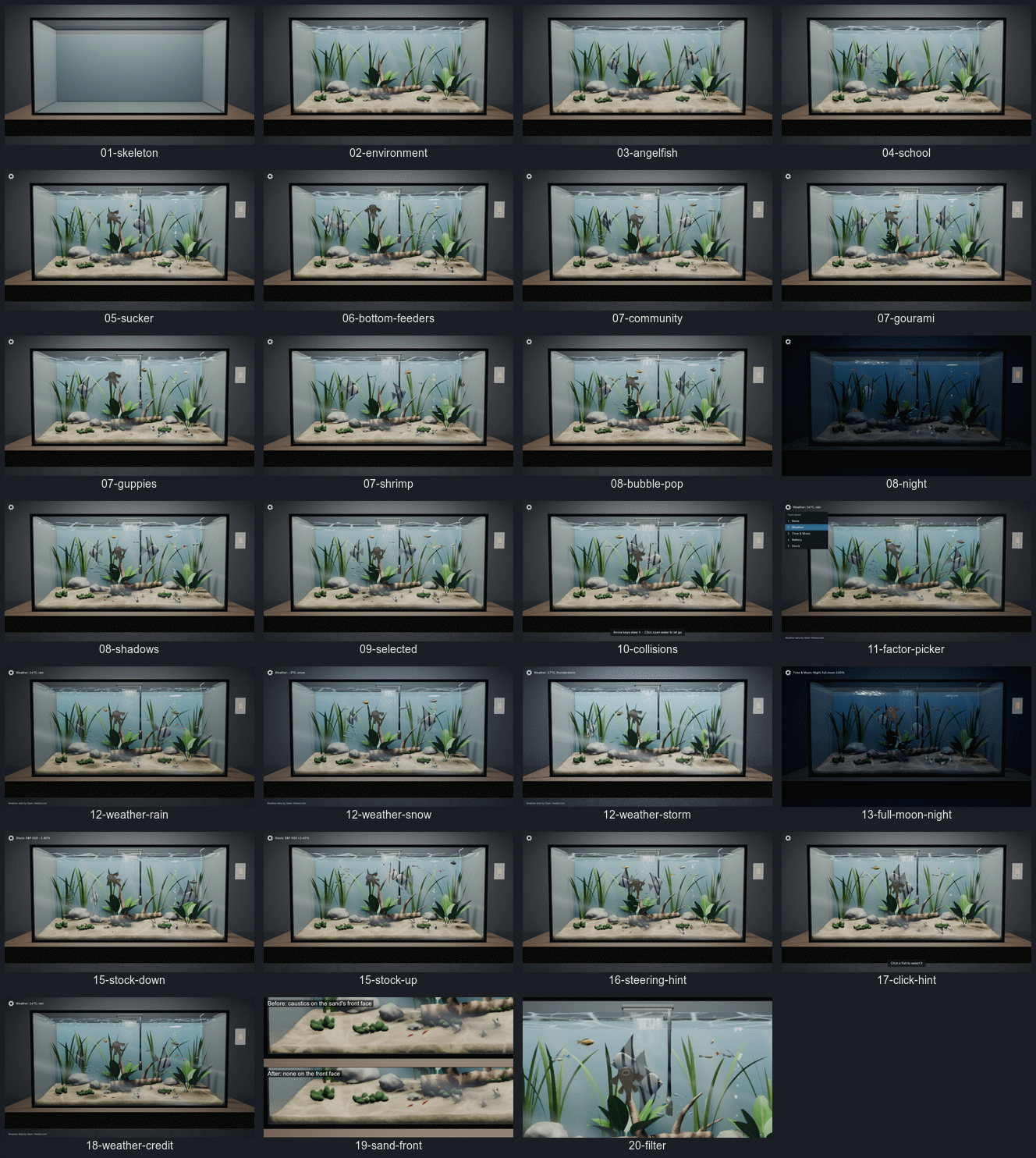
Shown above: Every screenshot in tankful's docs/shots directory, in the order the steps were built.
As they worked, the agents made 268 judgement calls, each recorded for review, and workers filed 14 problems they found outside their own tasks as new tasks. Workers asked no questions. The Manager asked the user one, about a problem in Wing itself. The run made 68 tasks and 49 commits.
The first session ran on October 16, 2026, from 1:13 pm to 11:08 pm. The next morning, three more prompts refined the result in about an hour:
When I click on and steer a fish, it should move faster than it does naturally.
The shadows of the light from the surface of the water show up also on the front surface of the sand, which makes no sense because it would not have the light from the top shining on it
The plants don't move at all, which doesn't look realistic since there would be at least some slow currents in the water, particularly due to any filter pumping water through.
The Result
The finished tank has 35 animals of seven kinds. Neon tetras swim as one school, a bristlenose pleco clings to the front glass, corydoras sift the sand, and angelfish, guppies, honey gouramis, and cherry shrimp each move in their own way. Plants sway in the current of a filter, and bubbles pop in rings on the surface:
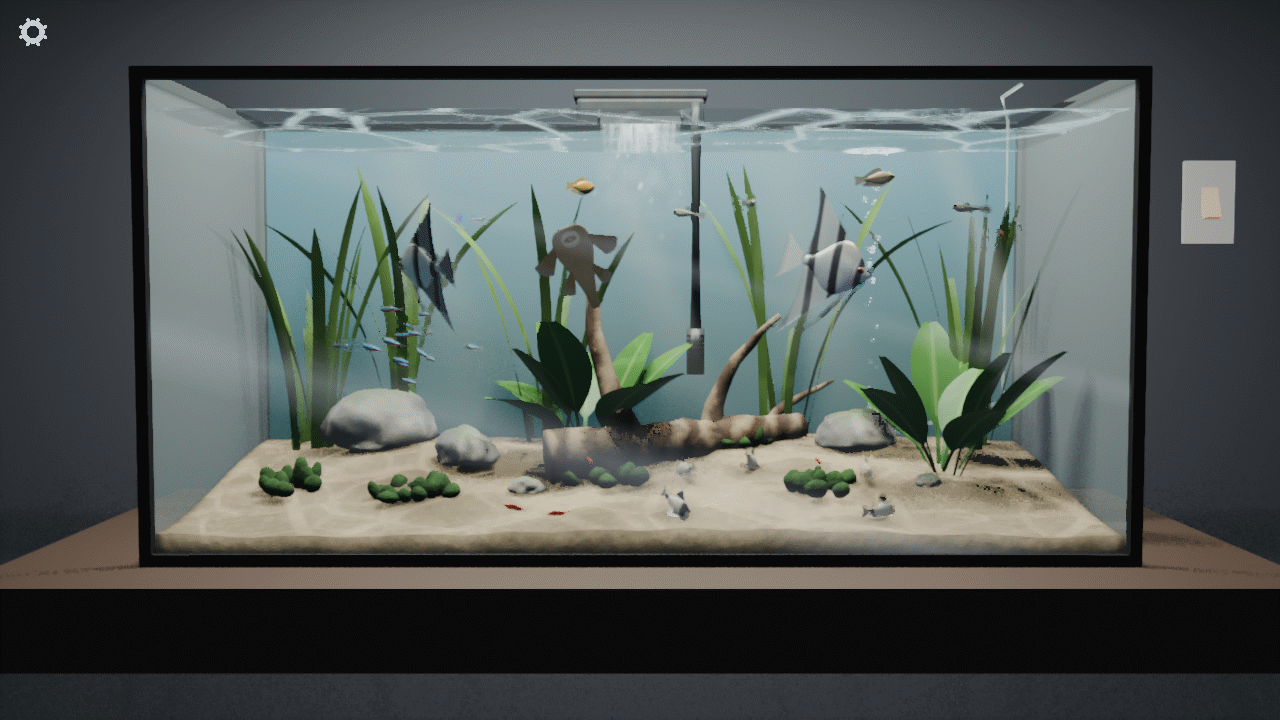
Shown above: The full community tank.
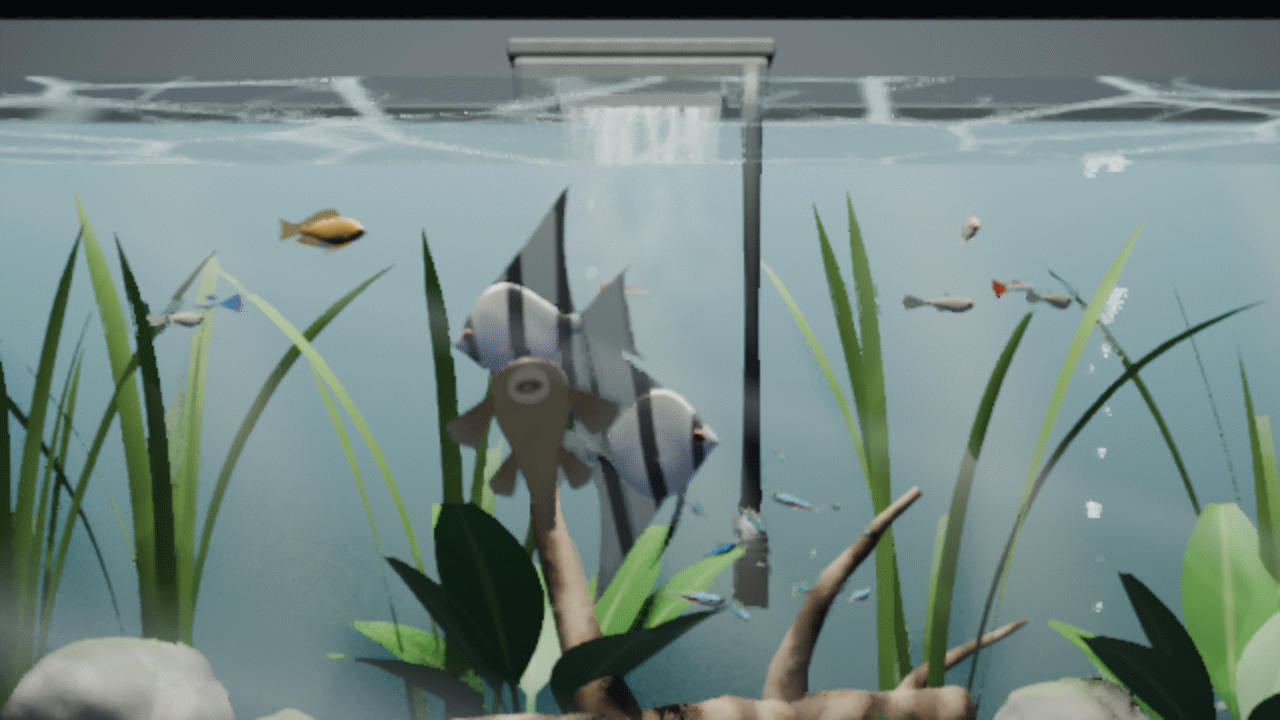
Shown above: The hang-on-back filter, with angelfish, a pleco, and tetras.
The outside factors are picked from a menu at the top left of the window. Weather brings rain, snow, or a thunderstorm whose lightning startles the fish, and Time & Moon follows the real day and lights the tank at night by the moon's current phase:
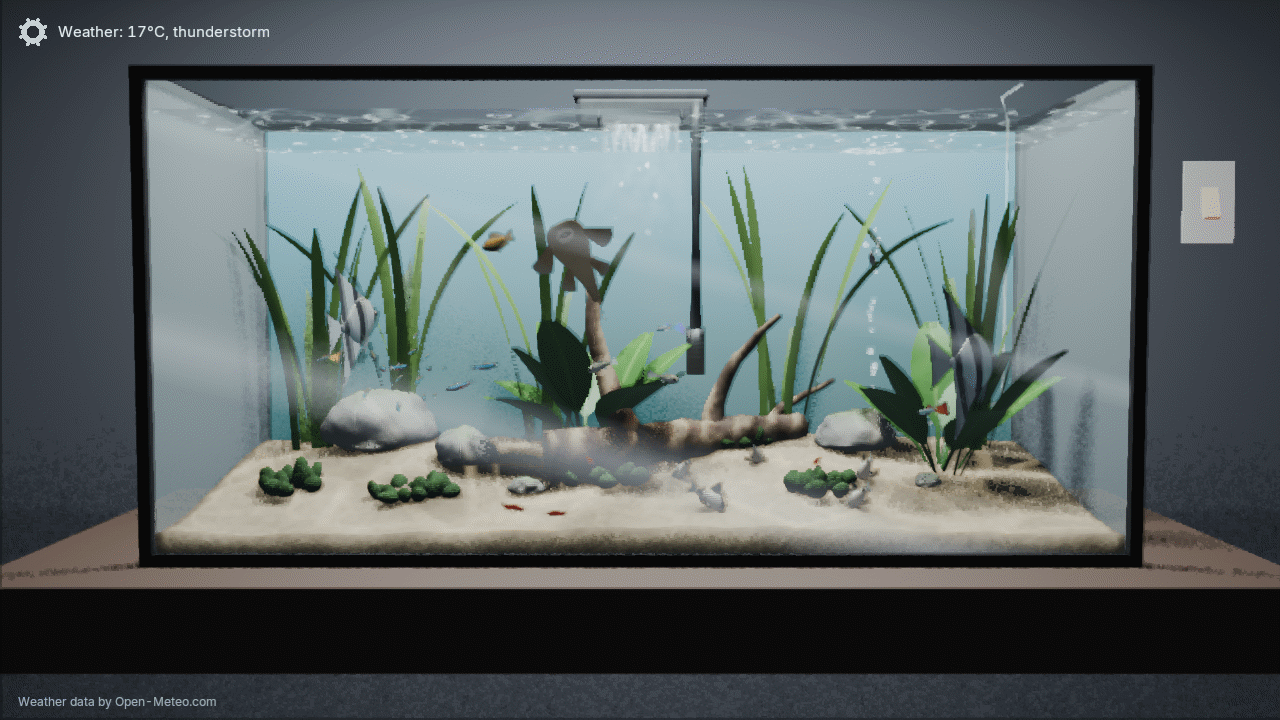
Shown above: The Weather factor during a thunderstorm.
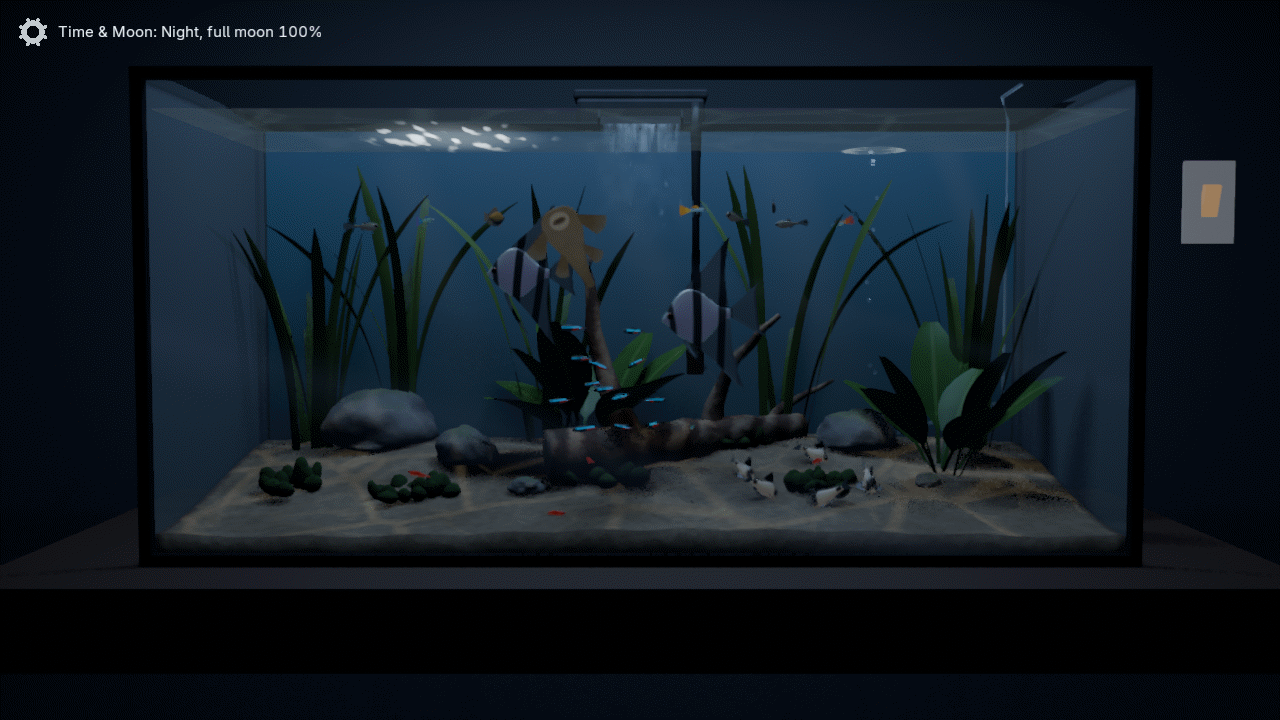
Shown above: The Time & Moon factor at night, under a full moon.
Notes
Not everything was finished. Fifteen proposed follow-ups were left unrun. tankful was built and run on macOS, and on Linux only in a Docker container with software rendering. It has not been run on Windows, since no machine was available to test it. The project's README says which platforms were checked and how.
tankful was a new project with no existing code to fit into, and the test harness built in the first step let agents see the results of their own work. Both made it easier than adding features to a large existing codebase.
Wing gives agents its IDE's features as tools on its MCP servers, and the run record counts how the agents used them. The Tasks Manager made 93% of its tool calls to Wing's tools. Workers ran 109 of their 153 test runs with Wing's test tools, and nearly every commit went through Wing, with only 3 git commits made in the shell. In 11 tasks, workers used Wing to edit Python code by function or class, finding and replacing each one in a single step. In this run they also found code with grep, find and their own search tools, 684 times, and looked at changes with git in the shell. None used the debugger. Use of Wing's MCP tools in the run record has the full counts.
The run record gives, for each task, the prompt, the judgement calls and the alternatives considered, the findings filed, the commits, and the time each took. It also lists the Manager's decisions and the places where it redirected a worker, for example when two tasks running at the same time were editing the same file. run-trail/trail.json has the same data.
Try it Yourself
To repeat a run like this one, you need Wing Pro 12.1 or later and an AI agent such as Claude Code, with an account that covers sustained use. Getting Started with Autonomous Development walks through the setup, and AI Agent-Assisted Development in Wing's documentation covers the Tasks Manager in full.
To run tankful itself, follow the install steps in its README.